
Types of Relationships
Introduction
Tables contain primary and foreign keys to specify relationships.
- Primary keys:
- The column(s) that identify the unique objects in a table.
- Foreign keys:
- The column that links to a primary key in another table.
There are different types of relationships:
- One-to-one
- One-to-many
- Many-to-many
In this module, we will learn about these relationships and their differences.
1. One-to-one relationship
In a one-to-one relationship, 1 record from one table is linked to 0 or 1 record from another table.
Let's look at the following example:
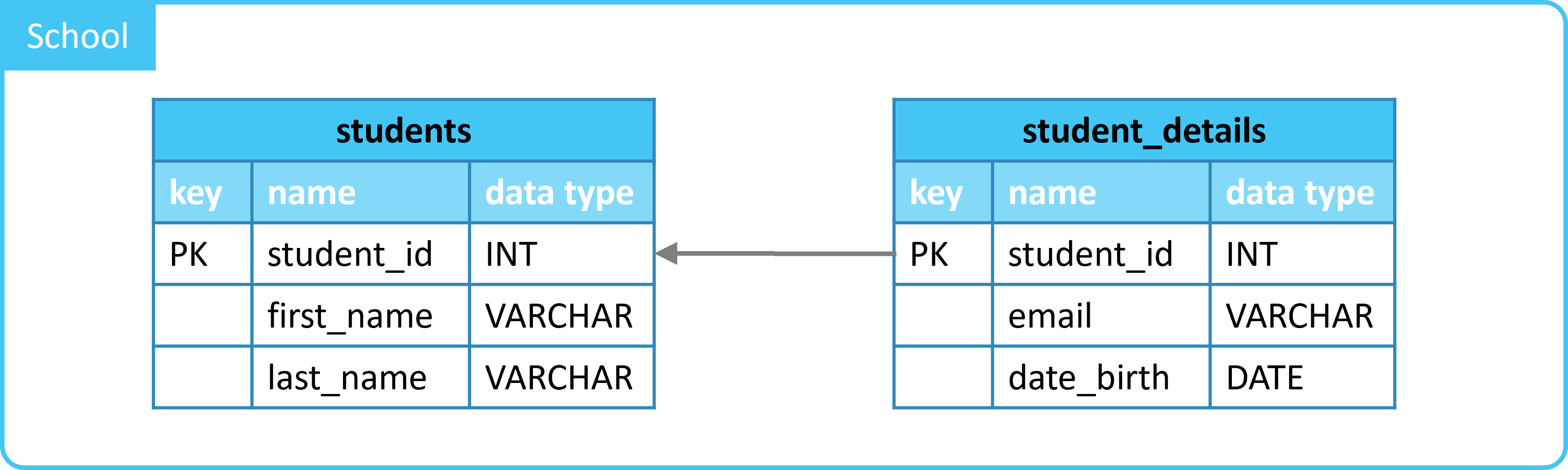
Here we see the following:
- Table
studentscontains the first name and last name of students.- Each row contains data of a unique student.
- Primary key is column
student_id.
- Table
student_detailscontains details of a student: email and date of birth.- Each row contains details of a unique student.
- Primary key is column
student_id.
Here, 1 record from table students is linked to 0 or 1 record from table student_details.
This is based on matching columns student_id.
The one-to-one relationship occurs, for example, when many columns are needed to process all the details of an object.
For better overview, the data is then distributed over multiple tables.
2. One-to-many relationship
In a one-to-many relationship, 1 record from one table is linked to 0 or multiple records from another table.
Let's look at the following example:
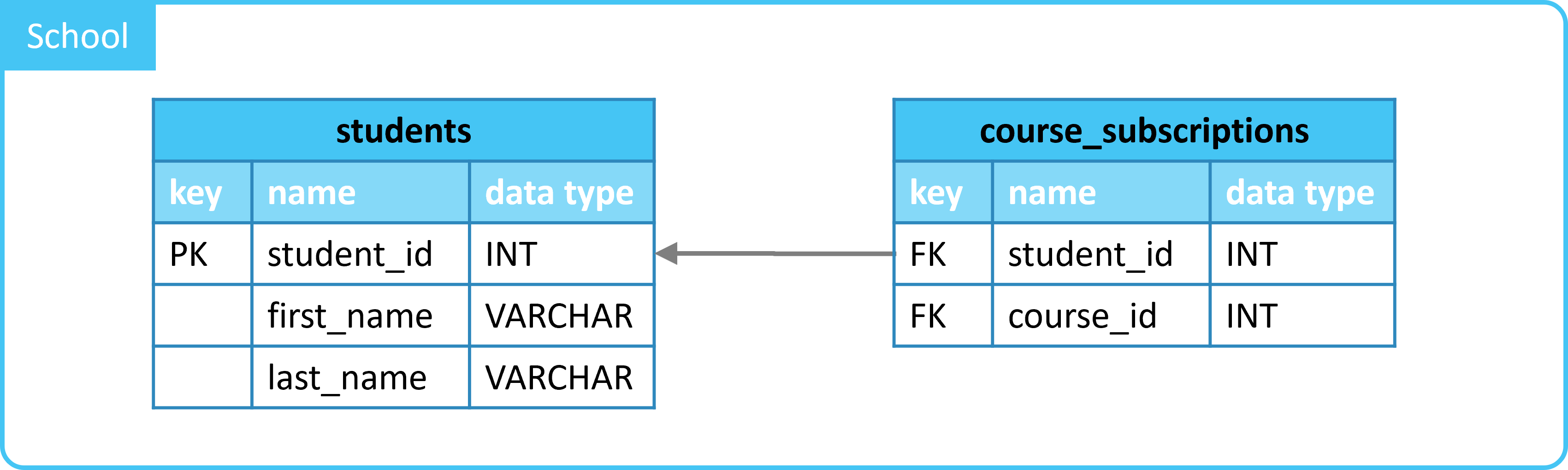
Here we see the following:
- Table
studentscontains the first name and last name of students.- Each row contains data of a unique student.
- Primary key is column
student_id.
- Table
course_subscriptionscontains the courses for which a student is enrolled.- Each student can be enrolled in multiple courses.
- A foreign key is column
student_id.
Here, 1 record from table students is linked to 0 or multiple records from table course_subscriptions.
This is based on matching columns student_id.
The one-to-many relationship is the most common in practice.
There is generally a relationship between a primary key and a foreign key.
3. Many-to-many relationship
In a many-to-many relationship, 1 record from one table is linked to 0 or multiple records from another table, and vice versa.
Let's look at the following example:
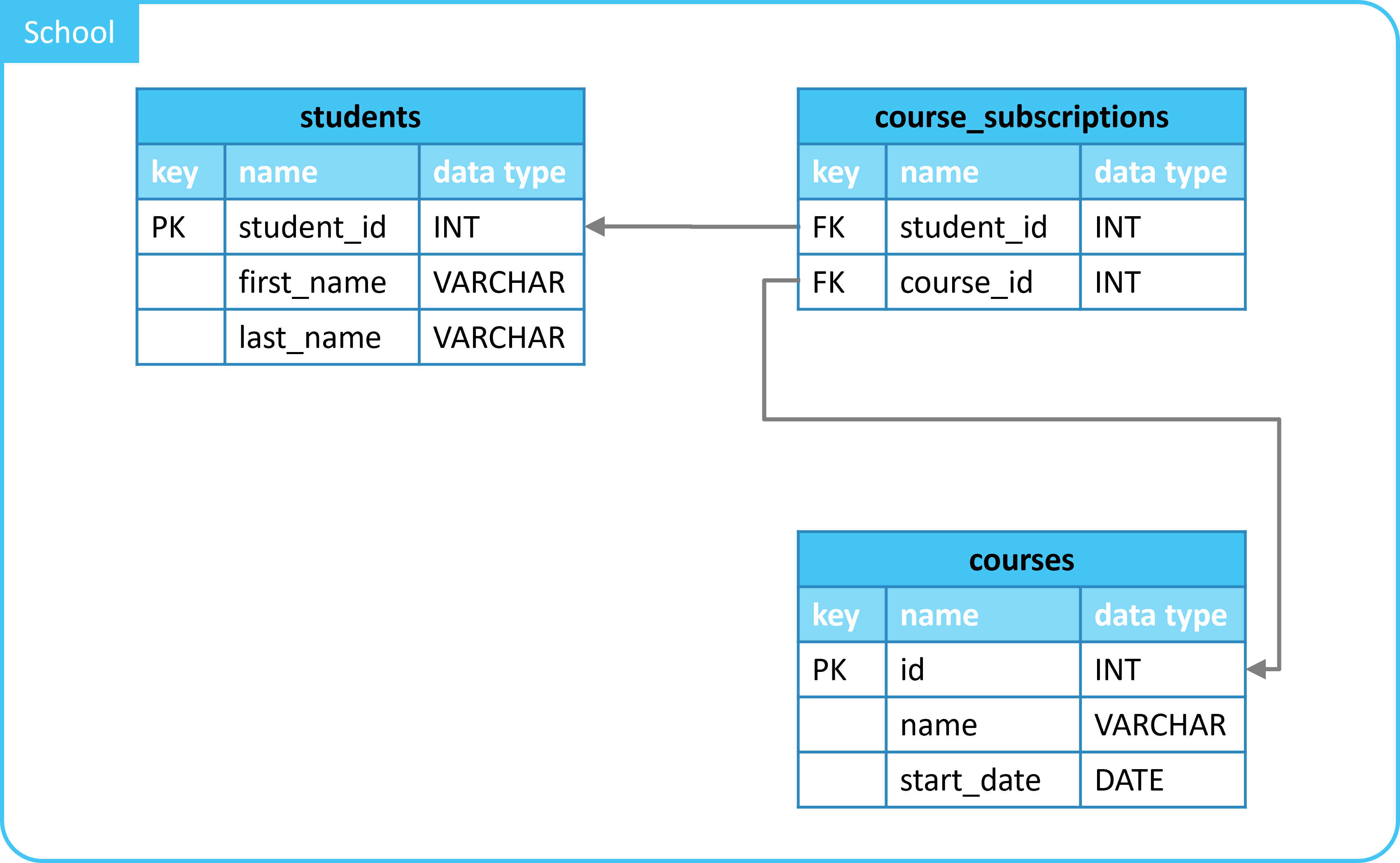
Here we see the following:
- Table
studentscontains the first name and last name of students.- Each row contains data of a unique student.
- Primary key is column
student_id.
- Table
course_subscriptionscontains the courses for which a student is enrolled.- Each student can be enrolled in multiple courses.
- A foreign key is column
student_id. - A foreign key is column
course_id.
- Table
coursescontains details of the courses.- Each row contains data of a unique course.
- Primary key is column
course_id.
Each student can be enrolled in multiple courses. Each course can be taken by multiple students.
There is generally a relationship between a primary key in one table, via foreign keys in an intermediate table, with a primary key in another table.
Summary
- There are different types of relationships:
- One-to-one
- 1 record from one table is linked to 0 or 1 record from another table.
- One-to-many
- 1 record from one table is linked to 0 or multiple records from another table.
- Many-to-many
- 1 record from one table is linked to 0 or multiple records from another table, and vice versa.
- One-to-one
- The one-to-many relationship is the most common in practice.