
Merging Data with RIGHT-, INNER- and FULL JOIN - Exercises
1. Most Used
We are now familiar with different types of JOIN statements.
Which of the following is the most used?
- 🔲
INNER JOIN - 🔲
FULL JOIN - 🔲
LEFT JOIN - 🔲
RIGHT JOIN
2. RIGHT JOIN
We are now familiar with different types of JOIN statements.
Which statements are true for a RIGHT JOIN:
- 🔲 It is the reverse of a
LEFT JOIN. - 🔲 It returns all results from both tables.
- 🔲 It only returns results with a match in both tables.
- 🔲 You sometimes use it for better overview when merging more than 2 tables.
3. (Extra) Which JOIN?
We have a database with HR data.
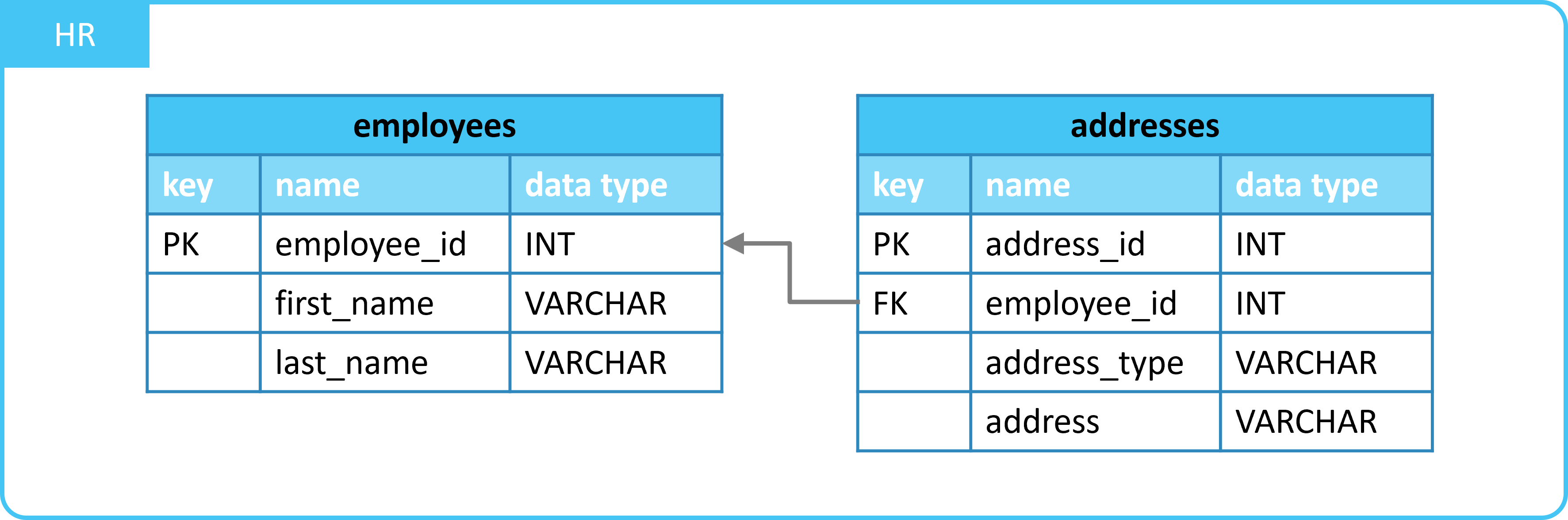
In it, we have 2 tables:
* employees
* First and last names of employees.
* addresses
* Addresses.
Consider the following:
* Not every employee has a known address.
* The addresses table contains addresses of employees, as well as suppliers and customers.
* You want to send a newsletter to all employees.
* For this, you want to compile a list of addresses.
Which JOIN would you use for this?
- 🔲
INNER JOIN - 🔲
FULL JOIN - 🔲
LEFT JOIN - 🔲
RIGHT JOIN
Write a query that returns the following: * Data of all employees with their addresses. * Only where an address is known.
Note, these tables are not in the database we use. You do not need to test your query.